A chore app for couples that stops one person nagging
A chore app for couples lets you split chores fairly by assigning each task to one person, so the reminders go to the assignee instead of the partner who keeps chasing. Houseloop hands a task off and reminds the person doing it, rotates recurring chores automatically, and syncs across both phones. The same engine runs your baby duty and household follow-through, so no one partner ends up the default parent or the default chore-tracker.


Try limited household task sharing free. Baby care and recurring routines require Plus. Eligible monthly subscribers can try Plus free for 7 days. Use it in your browser.
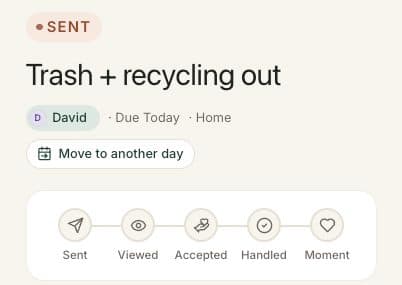
The reminder goes to the assignee, not you
Hand a task off and the reminders route to the person doing it. You stop being the one who has to remember it and chase it. The app does the chasing, so being organized is not the same as being the nag.
Recurring chores rotate on their own
Set a chore to alternate and it flips owners each cycle. Trash one week is yours, next week is theirs. Nobody has to renegotiate whose turn it is or keep a mental tally of who did it last.
One shared list on both phones
Houseloop syncs across both partners phones, so there is one source of truth for what is assigned, what is done, and what is left. No parallel lists, no it is not on my list, no double-doing.
More than chores when you need it
The same follow-through engine runs baby duty, night feeds, and a family notice board. When kids arrive it already handles who is on duty, so one parent does not silently become the default.
Try one real handoff together
Create your household and invite your partner from Family, so each person uses their own account. Pick one chore that matters this week, add a clear next step and due date, and assign one owner. Start with a small task such as taking out the bins, not your entire household backlog.
The owner accepts and completes the responsibility. Check the shared plan to see the result instead of sending another reminder yourself. For repeating chores, use Plus to create a routine and rotate ownership. Agree together on what done means; photo proof is optional, not a substitute for trust.
Free lets you and one invited person try up to three active responsibilities, one handoff per week, and one successful Brain Dump. Recurring routines, shared groceries, Baby Tracker, and ongoing automation require Plus. One Plus subscription covers the household.
How do you split chores fairly as a couple?
The unfair part of chores is usually not the doing, it is the tracking. One partner ends up holding the whole list in their head, noticing what needs doing, and reminding the other person. That invisible work is the load, and it is why splitting chores fairly means splitting the remembering too, not just the tasks.
Houseloop moves the remembering into the app. You assign each task to one person, and that person gets the reminders directly. The partner who used to carry the list stops being the human alarm clock. Fair here means each task has one clear owner and the app, not a person, is responsible for the nudge.
How do you stop being the one who always nags?
Nagging happens when reminders live in one partners head and have to be delivered out loud. It feels like nagging on both sides even when nobody means it to. The fix is to take the reminder out of the relationship and put it in a tool that pings the right person at the right time.
In Houseloop, when you hand a task off, the reminders go to the assignee, not back to you. You are no longer the messenger. If a recurring chore is set to rotate, it simply changes owner on schedule without a conversation. The person on the hook gets reminded because the app assigned it to them, not because their partner is watching the clock.
What happens when a couple becomes parents?
Chore imbalance quietly gets worse with a baby, because a whole new category of invisible work appears overnight: feeds, diapers, wakings, and the mental map of when the baby last ate. Houseloop is built to catch that, because it is a baby tracker and a household follow-through app running on the same engine.
Logging a feed, diaper, or nap in real time notifies the other parent (Dad logged feed 4.5 oz), and Baby Duty Autopilot routes the next feed reminder to whoever is on duty instead of waking both of you. That is the same principle as chore hand-off applied to nights, so neither partner drifts into being the default parent.
Most shared chore apps give couples a list. The gap is what happens after a task is assigned: who gets reminded, and whether one person still has to run the whole thing.
| Houseloop | Typical shared chore lists | |
|---|---|---|
| Who the reminder goes to | The assignee gets the reminder directly when you hand a task off. | Often one shared list; the organized partner still has to nudge the other. |
| Recurring chores | Rotate owners automatically each cycle, no renegotiation. | Repeat, but usually keep the same owner unless you edit them. |
| Invisible mental load | Moved into the app, so one person stops being the default tracker. | Left with whoever set up and maintains the list. |
| When a baby arrives | Same engine adds baby duty, feed reminders, and night-shift routing. | Chores only; a separate baby app to juggle and re-split. |
| Sync across partners | One shared source of truth on iPhone, Android and the web. | Varies; some are single-device or need manual sharing. |
Questions
What is the best chore app for couples?
The best chore app for a couple assigns each task to one owner and sends the reminder to that person, not to the partner who has to chase them. Houseloop does this and rotates recurring chores automatically, so being organized does not make you the household nag.
How does Houseloop help split chores fairly?
Houseloop lets you assign each chore to one person, and the reminders go to that assignee instead of their partner. Recurring chores can rotate owners each cycle, so the tracking and the reminding are shared, not just the tasks.
Does the reminder go to my partner or to me?
When you hand a task off to your partner in Houseloop, the reminders go to them, not to you. You stop being the one who has to remember and follow up, which is what makes it feel less like nagging.
Can recurring chores rotate between two people?
Yes. You can set a recurring chore to alternate owners, so it switches between the two of you each cycle automatically. Neither person has to keep track of whose turn it is.
Is the couples chore app free?
Start with the limited Free plan: one household, you and one invited person, up to three active responsibilities, one handoff per week, and one successful Brain Dump. Plus adds recurring routines, groceries, Baby Tracker, and more. Eligible new subscribers can try the monthly Plus plan free for 7 days. One subscription covers the household; prices and eligibility are shown before purchase.
Keep reading
Assign the next chore in Houseloop and let the app, not you, remind whoever is on the hook.
Works on web, iOS and Android. One Plus subscription covers the household. Check checkout for local prices and trial eligibility.